Get my lab interpretation

Your bloodwork looks fine.
But your body feels otherwise.

Kascade turns your bloodwork into the PMOS interpretation you’ve been searching for at midnight. Every value mapped to published research. Every claim cited inline. Explained the way a brilliant friend who’s actually read the studies would.

PMOS is the term Kascade uses for what you may know as PCOS. It emphasizes the broader polyendocrine and metabolic systems the research recognizes. We use both.

Not ready yet? Start free.

The PMOS Lab Decoder Guide walks you through the 7 biomarkers worth asking your doctor about, with the research-backed targets that matter in PMOS. Sent to your inbox right away.

Free

PMOS Lab Decoder Guide. 7 biomarkers your doctor may not explain, and what optimal actually looks like for your body.

Please enter your name.
Please enter a valid email.

Something went wrong. Please try again.

By submitting your email, you agree to receive educational content and updates from Kascade Health™. We respect your privacy and will never sell your information. You can unsubscribe at any time. Kascade Health™ is an educational platform and does not provide medical advice.

You’re in.

Your Lab Decoder Guide is on its way to your inbox.

40+ peer-reviewed PMOS studies powering every interpretation
Every claim cited from the primary source
Duke PhD-built by Dr. Rios, line by line
The reality of PMOS care

You’ve been asking
the right questions.

01
0%

of women say they left their PMOS diagnosis feeling under-informed.

Gibson-Helm et al., 2017 (n=1,385)

02
0%

search online to fill the gaps their provider didn’t have time for.

Hoyos et al., 2020 (n=729)

03
2+yrs

average time from first symptoms to a confirmed PMOS diagnosis.

World Health Organization

04
0%

of women with PMOS are walking around undiagnosed today.

World Health Organization

This is the gap a 15-minute appointment can’t close. Kascade was built to.

Reality check

The tab you’ve already been running.

$350
Per specialist visit
out of pocket

You had fifteen minutes. You had about an hour’s worth of questions.

You left with next steps but not always the full context you wanted. The interpretation gap is real, and it falls on you to fill it.

$1,500
Per year in supplements
on average

Myo-inositol. Berberine. Magnesium. NAC. Maybe all four, because why not.

When you read that something helps with PMOS, you try it. Without knowing which pattern actually drives your symptoms, every purchase is an informed guess, and the cart keeps growing.

500+
Hours researching
sometimes thousands

Reddit at midnight. Podcasts on your commute. Provider notes re-read six times.

The effort has been real. The issue is that none of it felt anchored to your own data, so the pieces never fully clicked into place.

PMOS isn’t one condition.
It has distinct patterns.
Yours is in your data.

Your data already has something to say. The interpreter helps you make sense of it.

Tap a card to see the patterns the research identifies.

Pattern 01
Glucose & Insulin Regulation

Blood sugar & metabolic patterns

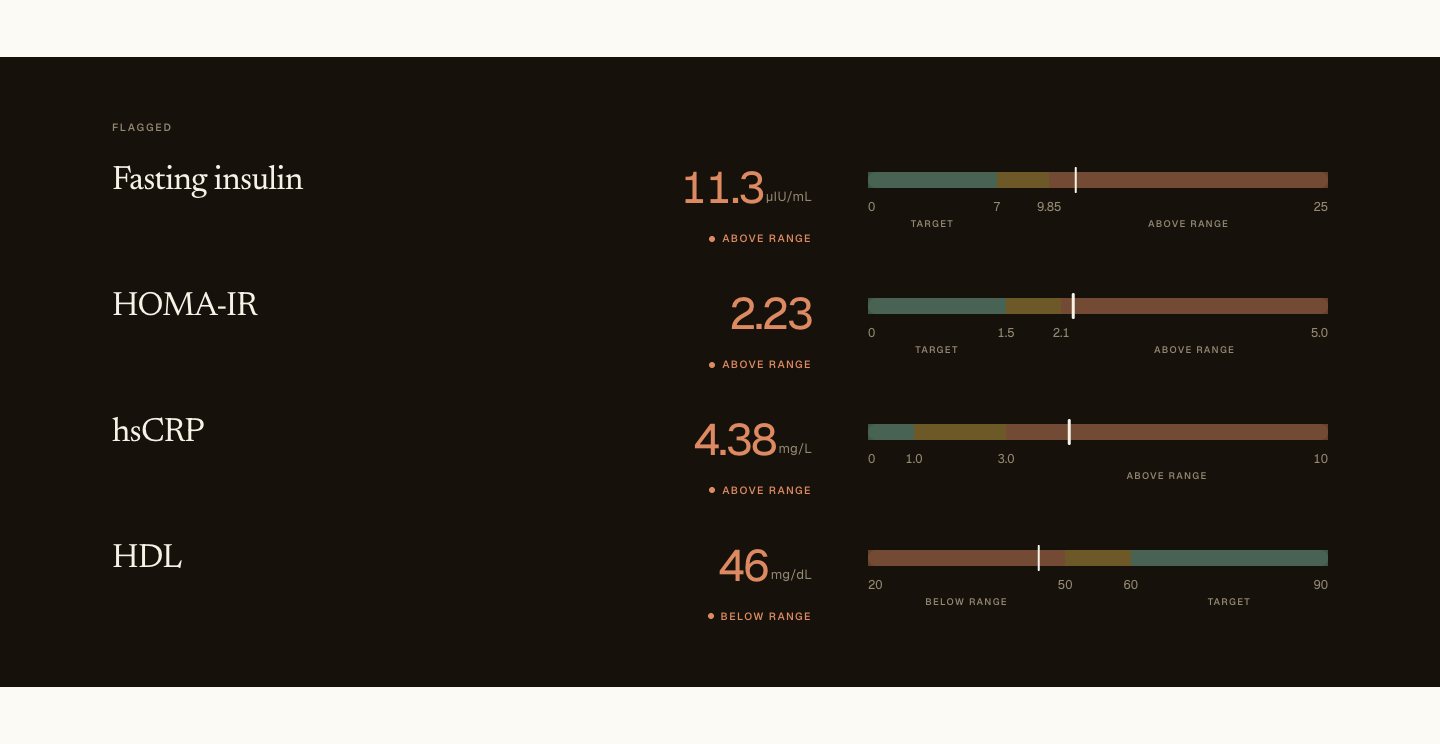
Hunger that doesn’t match what you ate. Energy crashes after meals. Weight that doesn’t respond to effort. Research consistently identifies insulin-related patterns as a primary metabolic driver in PMOS. One that standard lab reference ranges often don’t flag.

Pattern 02
Systemic Inflammation

Inflammatory markers & immune activity

Persistent fatigue, brain fog, a body that feels reactive even when nothing looks obviously wrong. Research documents chronic low-grade inflammation across multiple PMOS phenotypes. Measurable, and often overlooked.

Pattern 03
Stress Response & Adrenal Function

Also called HPA axis or adrenal PMOS

A PMOS pattern driven primarily by adrenal hormones rather than ovarian ones. A distinct subtype the research identifies as having different implications. Elevated DHEA-S alongside relatively normal reproductive hormones is a common presentation.

Ready to see which pattern your data is most consistent with?

Get my lab interpretation · $97 →
How it works

Your data. The research.
A report you can act on.

Kascade reads your lab values against published PMOS literature with every claim cited inline. Most people run their first interpretation in under ten minutes.

The flow
  1. 01
    Enter your labs Have results? Enter them directly. Starting fresh? Kascade points you to a PMOS-focused panel through Ulta Lab Tests. Lab costs are separate.
  2. 02
    See your pattern in research context Your values mapped against PMOS-specific research. Plain-language explanations, not clinical shorthand.
  3. 03
    Bring it to your provider Every point cites the study behind it. Walk into your next appointment as a fully informed participant with the literature in hand.
  4. 04
    Run it again when you retest New labs in six months? A fresh interpretation against your updated values. No subscription. Pay $97 only when you actually want a new report.
What’s in your report
  • Every lab value mapped to researchAgainst curated PMOS-specific peer-reviewed literature.
  • Root-cause pattern readWhich metabolic pattern your data is most consistent with, and what the research says.
  • Plain-language explanationsWhat each marker measures and what optimal looks like for PMOS, not the general population.
  • Provider conversation prepSpecific, research-grounded questions tailored to your numbers.
  • Citations for every claimHand the report to your doctor. Ask the real questions. Walk in with sources.
See the difference

The same lab value. Two completely different stories.

Your standard lab printout calls a fasting insulin of 14.2 “normal.” Here’s what Kascade tells you about the same number, using the research your provider didn’t have time to walk you through.

A standard lab printout
PATIENT · FEMALE · 32YO
FASTING INSULIN
14.2 µIU/mL
REFERENCE RANGE
2.6 – 24.9 µIU/mL
RESULT
NORMAL
Your Kascade interpretation
Sample marker from your report
Kascade Health

Fasting Insulin 14.2 µIU/mL

Standard “normal” on your lab report: 2–25 · PMOS research has found hormone effects above: 8–10 · Your value: 14.2 µIU/mL

Your 14.2
07 optimal10 watch25
What this number measures

Insulin is a hormone your pancreas makes to move sugar from your blood into your cells. Fasting insulin is measured before you eat. It shows how much your body is producing just to stay stable at rest. Your result of 14.2 means your body is working roughly twice as hard as it typically would at rest, just to maintain blood sugar without any food in your system.

You may recognize this as:
  • An energy crash 2–3 hours after eating
  • Cravings that feel physical and urgent, not just habit
  • Weight that won’t budge despite eating reasonably
  • Difficulty concentrating in the afternoon
What this might be causing

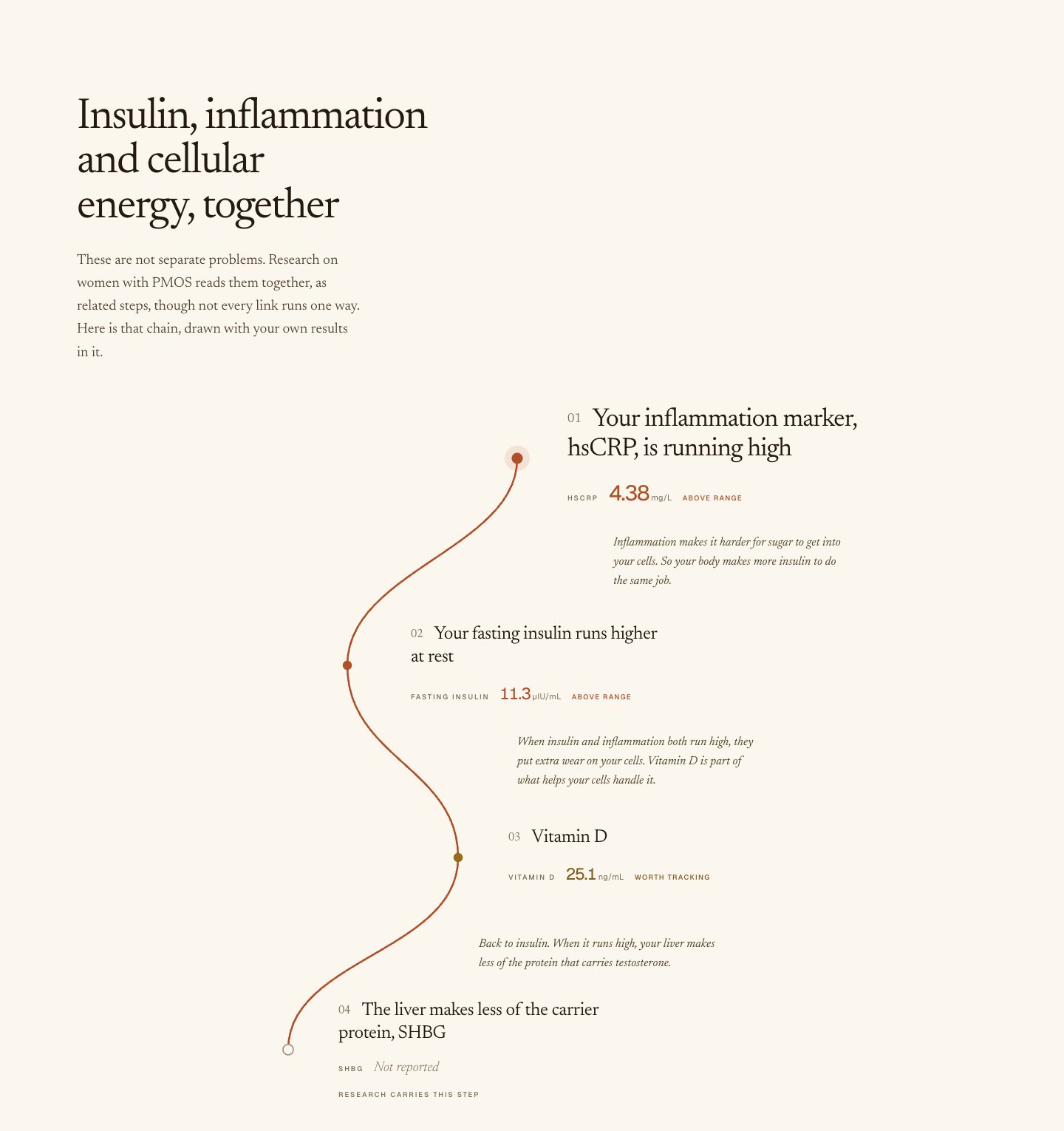
When insulin stays elevated, it sets up a spike-and-crash blood sugar pattern that drives afternoon fatigue and intense cravings. It also directly reduces SHBG production in your liver, which is the chain reaction connecting your insulin level to the hormonal symptoms you may be seeing on your skin, hair, or cycle.

Why a standard panel might not highlight this

Your value of 14.2 falls within the standard “normal” range of 2–25, so a typical panel wouldn’t highlight it. PMOS research has found that values above 8–10 are associated with the hormonal effects that cause symptoms. The general-population cutoff wasn’t built with PMOS in mind.

Cited from peer-reviewed research
Diamanti-Kandarakis E, Dunaif A. “Insulin resistance and the polycystic ovary syndrome revisited.” Endocrine Reviews. 2012;33(6):981–1030.

Found that elevated fasting insulin in PMOS is the upstream driver of the hormonal symptoms most often described as the condition itself, even when blood glucose looks normal.

Every biomarker in your report gets this treatment, with the full story tied together.

The Kascade interpreter

“Think of it as the obsessively informed friend who’s actually read the studies, and can finally help you understand what your numbers mean. Rigorous, research-grounded, and entirely yours.”

How Kascade started

It began as a conversation.

A woman I’d been talking to was diagnosed with PCOS at fifteen. She told me the first thing her doctor offered was birth control, but what she actually wanted was to understand what was driving her symptoms and address it at the root. Nobody had ever mentioned myo-inositol to her. Decades of research on its role in metabolic and ovarian function, and she didn’t know it existed.

Then the same conversation kept happening. Friends. Family. Strangers in DMs. All asking me to look at their bloodwork. All wanting context the fifteen-minute appointment couldn’t fit.

So I built the tool. Kascade is what I wished those women had in the moment they were asking.

Who Kascade is for

If any of these sound like you, this was built with you in mind.

Founder
Dr. Jeovanna Rios, PhD

Dr. Jeovanna Rios, PhD

Biochemist. Science translator. Built Kascade for the woman who’s been her own researcher.

Most platforms borrowed their scientific credibility. Kascade was built from it.

Dr. Rios earned her PhD in chemistry from Duke. Her research was based in the Pratt School of Engineering’s Biomedical Engineering department, ranked top 5 globally. Her dissertation focused on metabolic engineering: the science of tuning metabolism toward a specific outcome.

She then spent three years in scientific affairs at a supplement manufacturer working with clinical-grade brands in women’s metabolic and hormonal health. That’s where her work moved into hormonal biochemistry. Several of the formulation concepts she helped develop are now in commercial products and in active clinical research.

Every framework inside Kascade was built against curated peer-reviewed PMOS literature, by her. Not an outsourced algorithm.

Common questions

Everything you might be wondering, before you decide.

One report. One price.

Run your labs.

For the woman who has been doing her own research for months, maybe years. A single interpretation, priced like one specialist co-pay, not a subscription.

Full lab interpretation
$97one-time

no subscription · no account required

Your complete root-cause pattern report, mapped against published PMOS research with every point cited. Run a fresh interpretation whenever you retest. Lab costs are separate.

Get my lab interpretation · $97 →

Kascade Health™ is a health education and literacy platform operated by Kascade Health LLC. It does not provide medical advice, diagnosis, or treatment recommendations. The AI lab interpreter provides educational context based on published research. It does not diagnose medical conditions or prescribe interventions. Always consult a qualified healthcare provider before making decisions about your health, medications, or supplements.